Soft Costs vs. Hard Costs: Why Your Custom Home Budget Is Bigger Than the Builder's Quote
The More You Know: Homebuilding Edition
Key Takeaways
- Hard costs are the physical construction of your home; soft costs are everything else required to make that construction legal, insurable, and financeable — and they're almost never included in a builder's headline number.
- Soft costs typically run 15% to 30% of your hard construction costs, depending on site complexity, location, and how customized your home is.
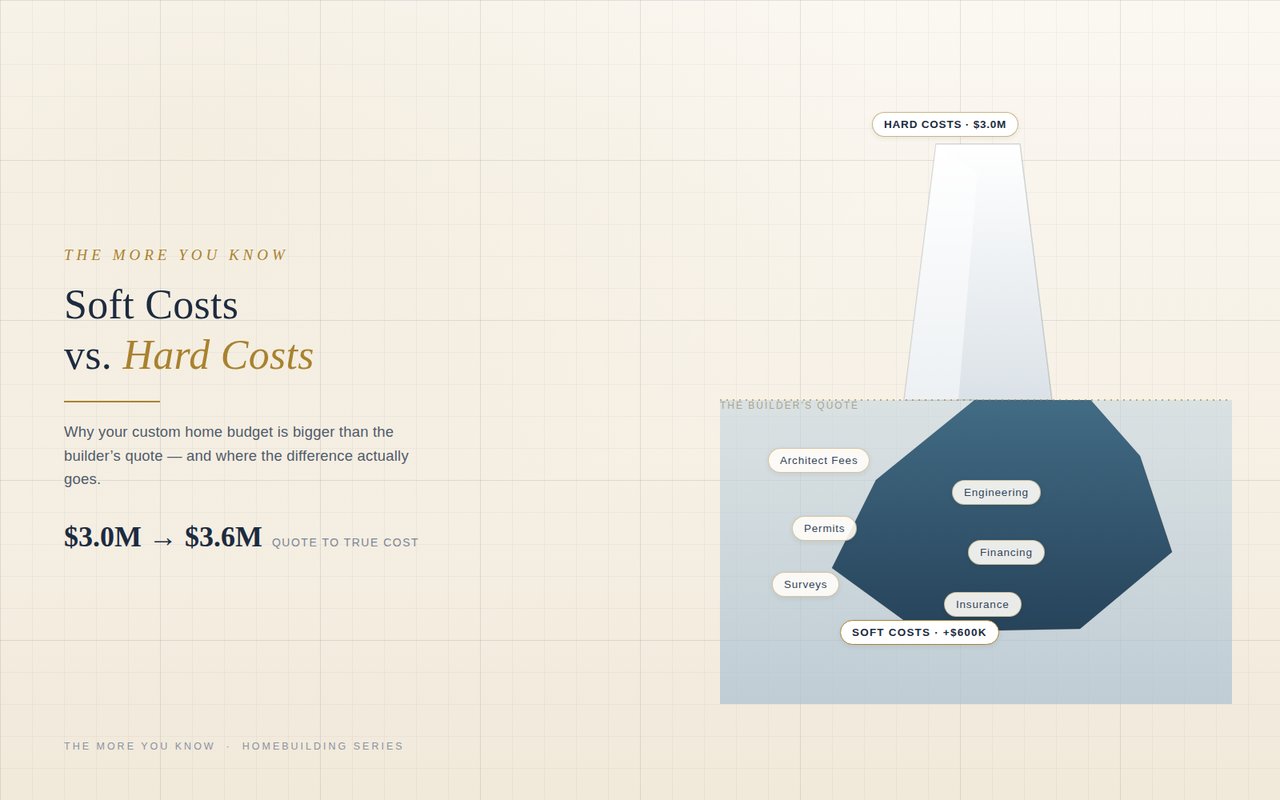
- On a $3 million construction quote, soft costs of 20% add roughly $600,000 — turning a $3M project into a $3.6M one before you've picked a single finish.
- The buyers who avoid sticker shock are the ones who budget for soft costs from day one, not the ones who find out at closing.
If you've ever heard a builder's quote and thought, "okay, that's the number," this one's for you.
What Are Soft Costs vs. Hard Costs?
Hard costs are everything you can physically point to in a finished home: the foundation, framing, roofing, plumbing, electrical, HVAC, windows, and interior finishes. It's the cost of labor and materials to actually build the structure. Soft costs are every professional, legal, financial, and administrative expense required to plan, permit, insure, and finance that construction — architecture and engineering fees, permits, surveys, financing costs, and insurance. Soft costs don't show up in the framing lumber, but you can't legally or financially build without them.
Think of it this way: hard costs are what you can touch. Soft costs are what makes touching it legal.
Hard Costs | Soft Costs | |
|---|---|---|
What it covers | Materials + labor to build | Planning, approval, financing, protection |
Examples | Foundation, framing, roofing, plumbing, electrical, finishes | Architect, engineer, permits, survey, loan interest, insurance |
Typically quoted by | The builder or general contractor | Rarely bundled into one quote — often paid separately, to separate parties |
% of total project cost | 70–85% | 15–30% |
When you feel it | Draw by draw, as construction progresses | Before you break ground, and throughout financing |
The Real Numbers: How a $3M Home Becomes a $3.6M Home
A $3 million construction quote from your builder covers hard costs only. Add a realistic soft-cost load of 18–25% — architecture, engineering, permits, surveys, financing, and insurance — and your true project cost lands between $3.54M and $3.75M, often landing right around $3.6M once every line item is accounted for.
Here's a representative breakdown for a $3M luxury custom build:
Soft Cost Category | Typical Range | Example |
|---|---|---|
Architectural design | 6–12% of hard costs | $180,000–$360,000 |
Structural, civil & MEP engineering | 2–4% of hard costs | $60,000–$120,000 |
Permits & municipal fees | 1–3% of hard costs | $30,000–$90,000 |
Surveys & geotechnical/soil testing | 0.5–1.5% of hard costs | $15,000–$45,000 |
Construction financing (origination, interest, appraisal) | 3–8% of hard costs | $90,000–$240,000 |
Insurance & builder's risk | 0.5–1.5% of hard costs | $15,000–$45,000 |
Total soft costs | ~18–25% | ~$540,000–$750,000 |
Every one of these ranges widens on a challenging lot — steep grade, poor soil, coastal or flood zones, historic districts, or a jurisdiction with a slow, expensive permitting process. On those sites, soft costs can climb toward 25–30% of hard costs rather than settling near the lower end.
The Full List of Soft Costs Most Buyers Forget
If a soft-cost line item isn't in your builder's quote, it's usually because it isn't the builder's to quote — it belongs to a different professional or process entirely. Here's what typically falls outside that number:
Design & engineering
- Architect fees (usually paid in phased installments over the design timeline, well before construction financing even closes)
- Structural, civil, and MEP (mechanical/electrical/plumbing) engineering
- Interior design and landscape architecture, if used
Site & regulatory
- Boundary and topographic surveys
- Geotechnical soil testing and environmental assessments
- Building permits and municipal review fees
- Utility connection and tap fees
Money costs
- Construction loan origination fees
- Interest accrued during the build (you're paying interest on a home you can't live in yet)
- Appraisal fees
- Builder's risk insurance and performance bonds
Oversight
- Project management or owner's rep fees, if you hire one
- Third-party inspections and testing
- Legal fees for contracts, easements, or title work
None of this is a builder padding their number — it's simply that a general contractor's quote covers construction, not the ecosystem of professionals and institutions required to get you there.
Why This Catches Even Experienced Luxury Buyers Off Guard
Most buyers have purchased a finished home before, where the sale price is the number. Custom construction breaks that mental model: the price you negotiate is only ever the hard-cost piece, and the soft costs accumulate quietly, across a dozen invoices from a dozen different parties, over the many months before and during the build. By the time all the soft-cost invoices are totaled, the gap between "what I was quoted" and "what I actually spent" can feel like a surprise — even though, item by item, every fee was reasonable and standard.
The buyers who feel blindsided almost always made one mistake: they budgeted to the builder's number instead of budgeting to the project's number.
How to Budget for Soft Costs From Day One
Add a soft-cost line to your budget before you get a single construction bid. A simple rule of thumb: take your expected hard-cost budget and add 20% as a placeholder for soft costs until you have firm numbers from your architect, lender, and civil engineer.
Get your architect and engineer fees in writing early. These are usually the largest soft-cost category and the easiest to estimate accurately months before construction financing is finalized.
Ask your lender for an all-in construction loan estimate, not just a rate. Origination fees, interest reserve, and appraisal costs vary meaningfully between lenders and should be compared the same way you'd compare mortgage rates.
Get your survey and geotechnical work done before you're deep into design. A difficult site discovered late is one of the fastest ways to blow both your hard-cost and soft-cost budgets at once.
Build in contingency on top of soft costs, not instead of them. A 10–15% contingency reserve is standard for hard costs; soft costs deserve their own buffer too, since permitting delays and design changes both carry real financial consequences.
Questions to Ask Your Builder Before You Sign
- Does this quote include architecture and engineering, or are those separate?
- Are permits and municipal fees included, and do you have an estimate for this jurisdiction specifically?
- Who is responsible for survey and geotechnical costs — is that already done, or is it still ahead of us?
- What's a realistic all-in soft-cost percentage for a project like mine, on this specific lot?
- Is there a project management or oversight fee, and is it included in this number?
A builder who answers these clearly and specifically, rather than in generalities, is one who's done this before at your level.
Frequently Asked Questions
What is the difference between hard costs and soft costs in construction?
Hard costs are the physical materials and labor required to build a structure — foundation, framing, systems, and finishes. Soft costs are the non-construction expenses required to plan, approve, finance, and insure the project, including architecture, engineering, permits, surveys, and financing costs.
What percentage of a construction budget is soft costs?
Soft costs typically range from 15% to 25% of hard construction costs for most custom homes, and can reach 25–30% on complex or challenging sites, in high-regulation jurisdictions, or on highly customized luxury builds.
Are soft costs included in a builder's quote?
Usually not. A general contractor's or builder's quote typically covers hard costs only — the physical construction. Soft costs are paid separately to architects, engineers, surveyors, municipalities, and lenders, often before construction financing even closes.
What are examples of soft costs when building a custom home?
Common soft costs include architectural design fees, structural and MEP engineering, permits and municipal fees, land surveys and geotechnical testing, construction loan origination and interest, appraisal fees, and builder's risk insurance.
How do I avoid being surprised by soft costs?
Add a soft-cost line to your budget — roughly 20% of your expected hard-cost total — before you request your first construction bid, get architecture and engineering fees in writing early, and ask your lender for an all-in construction loan estimate rather than just a rate.