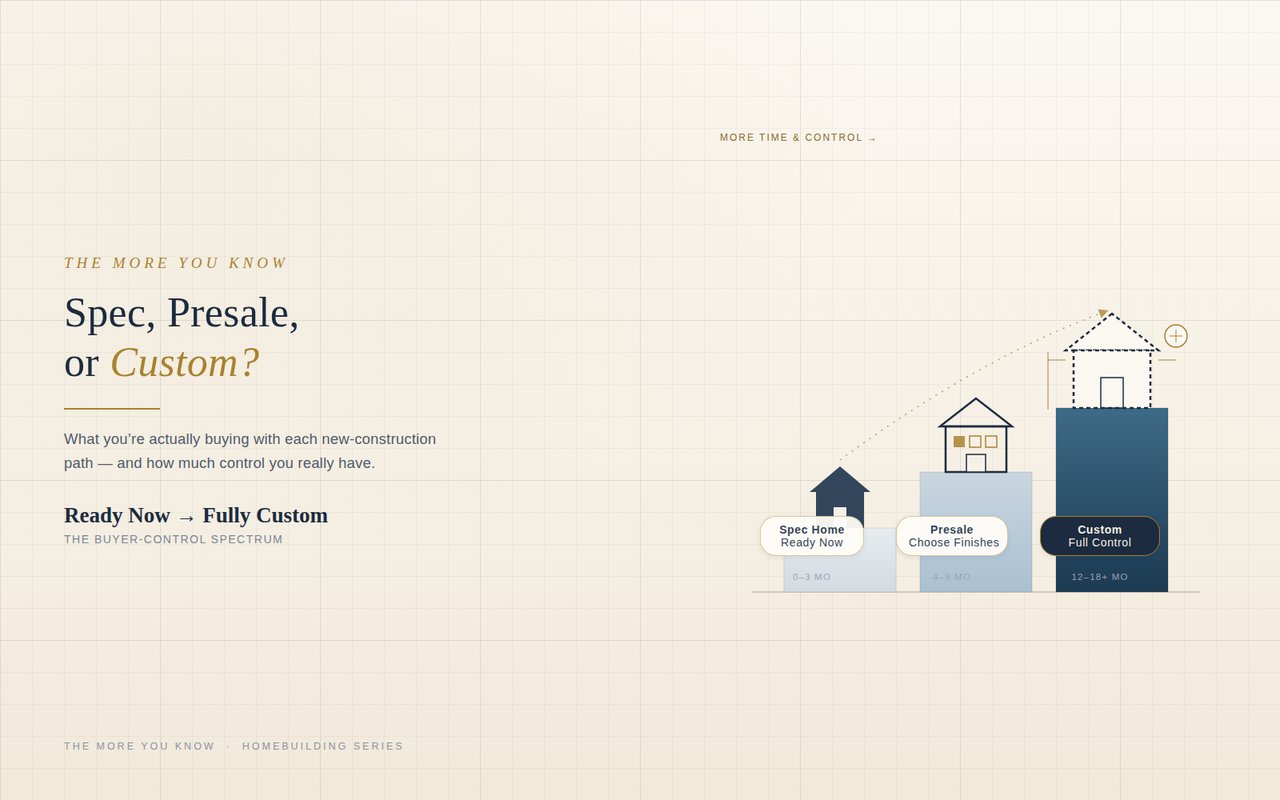
Spec Home vs. Custom Build vs. Presale: What You're Actually Buying
The More You Know: Homebuilding Edition
Key Takeaways
- A spec home is built by a developer on speculation, with no buyer attached — the builder makes every design decision, and you buy it finished or nearly finished.
- A presale home is reserved during construction, usually on the builder's own lot and floor plan within a community, with a defined menu of finish and layout options.
- A custom home is designed from scratch for one buyer, typically on a lot you own, with your own architect and full control over every decision.
- These aren't just marketing terms — they determine how much control you have, how long you'll wait, how predictable your price is, and how exposed you are to the soft costs covered in our last post.
Builders and listings use these three words loosely, and buyers often assume they're interchangeable. They're not — and knowing the difference changes what you should ask before you sign anything.
What Is a Spec Home?
A spec home — short for "speculative" — is a new construction home a builder designs, permits, and builds without a buyer under contract, betting that the finished product will sell. Every decision, from the floor plan to the countertops, has already been made by the builder before you ever walk through the door.
Spec homes are the closest new-construction path to buying a resale home: what you see is what you get, it's typically move-in ready or close to it, and financing works like a standard mortgage rather than a construction loan. The tradeoff is control — you're choosing from what's already built, not shaping what gets built.
Best for: Buyers who want new-construction quality without the design timeline, and who are comfortable with the builder's choices already made.
What Is a Presale Home?
A presale home is one you purchase before or during construction, on a lot and within a floor plan the builder has already established — typically inside a planned community or development — while still being able to select from a defined menu of finishes, and sometimes minor layout options.
Presale sits in the middle: you're not designing a home from a blank sheet of paper, but you're not buying something already finished either. You lock in a price at contract signing, often with a 5–10% deposit, and the builder constructs to your selections within their system. Because the home isn't finished yet, you typically avoid competing against other buyers for the same completed unit.
Best for: Buyers who want meaningful say in finishes and some layout decisions, price certainty locked in early, and a shorter runway than a fully custom build — without managing an architect and a build from the ground up.
What Is a Custom Home?
A custom home is designed specifically for one buyer, usually on a lot the buyer already owns or is purchasing separately, with an architect (often chosen by the buyer) creating a floor plan from scratch and the buyer controlling every material, system, and finish decision throughout the build.
This is the path with the least resemblance to buying an existing home. You're assembling a team — architect, engineer, builder — before a single wall exists, and every choice is yours to make, which is exactly why the soft costs we covered in our last post (architecture, engineering, permitting, financing) hit hardest here. It's also the path with the longest timeline: design alone can run four to six months before construction even begins, with construction itself typically running nine to twelve months or more.
Best for: Buyers with a specific lot, a specific vision, and the time and involvement to see it through — where personalization and long-term fit matter more than speed or cost predictability.
The Three, Side by Side
Spec Home | Presale Home | Custom Home | |
|---|---|---|---|
Who decides the design | Builder, entirely | Builder's plan; you choose from a finish/option menu | You and your architect, from scratch |
Lot | Builder-selected | Builder-selected, within their community | Usually buyer-owned or buyer-selected |
Timeline to move in | Immediate to a few months | Months, tied to the build schedule | 12–18+ months including design |
Price certainty | Known — you see the finished product before buying | Locked in at contract signing | Estimated upfront, but the most variable as decisions are made |
Financing | Standard mortgage | Standard mortgage, deposit at signing | Construction loan, converting to a mortgage at completion |
Buyer involvement | Minimal | Moderate — selections within a system | Extensive — ongoing decisions and project oversight |
Competition from other buyers | Yes, especially in strong markets | Low — it's reserved to you once under contract | None — it's yours from the start |
Which One Is Actually Right for You?
If speed and certainty matter most — you need to close within a few months, you want to see exactly what you're buying before you commit, and you're comfortable with someone else's design choices — a spec home is usually the fit.
If you want real input on finishes and some layout flexibility, without taking on the full weight of designing a home from nothing, and you're drawn to a specific builder or community — a presale home tends to be the sweet spot. You get a voice in the outcome and a locked-in price, without hiring your own architect.
If you have a specific lot, a specific way you want to live in the home, and the bandwidth to be an active participant for a year or more — a custom home is the only path that gets you there. It's also the path where budgeting for soft costs matters most, since you're the one assembling the professional team rather than buying into a builder's existing one.
Questions to Ask Before You Sign, Whichever Path You Choose
- If it's a spec home: what upgrades, if any, can still be negotiated before closing, and is the price truly final?
- If it's a presale home: what's included in the base price versus the option menu, and what happens to my deposit if I want to change my selections later?
- If it's a custom home: who owns the architectural plans if I switch builders mid-project, and what's the realistic all-in timeline including design, permitting, and construction?
- For any of the three: what's the builder's standard warranty, and can I see it in writing before I'm under contract?
Frequently Asked Questions
What is the difference between a spec home and a custom home? A spec home is built by a developer without a buyer attached, with every design decision already made before it's listed for sale. A custom home is designed from scratch for one specific buyer, who controls the floor plan, materials, and finishes from the start, typically on a lot they own.
What is a presale home in real estate? A presale home is a new construction home purchased before or during construction, usually on the builder's lot and within their established floor plan, where the buyer can select from a defined menu of finishes and sometimes minor layout options, with the price locked in at contract signing.
Is a presale home the same as a custom home? No. A presale home uses the builder's existing floor plan and lot with a limited menu of choices, while a custom home is designed from a blank page by the buyer's own architect, usually on a lot the buyer already owns, with far greater control and a longer timeline.
Which is cheaper: a spec home or a custom home? Spec homes are generally more predictable and often less expensive, since builders construct from proven, efficient floor plans at scale. Custom homes typically cost more and are more variable, since every decision — including the soft costs of architecture, engineering, and permitting — is made individually for one home.
Can I still customize a spec home? Customization on a spec home is minimal, since the builder has already made most or all design decisions. Depending on how far along construction is, buyers may be able to negotiate a small number of upgrades, but the base design is typically fixed.